
From Text to Something More Human
Every technology begins with a simpler version of itself.
Memento Vitae started as a text-only AI. It was designed to capture your thoughts, your memories, your perspective on life—and turn them into something structured, searchable, and interactive. You could “talk” to your AI profile, and it would respond in a way that reflected your reasoning, your beliefs, your experiences.
Even in that early form, something remarkable happened.
People didn’t just see it as a tool. They began to recognize themselves in it. The way answers were formed, the priorities reflected in decisions, the tone of explanation—it all felt familiar. It felt personal.
And yet, something was still missing.
Because no matter how accurate the words were, they remained… words on a screen.
They didn’t carry the pauses, the warmth, the subtle emotional texture that makes a person feel real. They didn’t echo the cadence of how you speak when you’re excited, thoughtful, or vulnerable. They didn’t sound like you. That realization led to a natural next step.
If Memento Vitae could think like you… could it also speak like you? The transition from text to voice is not just a technical upgrade. It’s a shift from representation to presence. From reading someone’s thoughts to hearing them. From interaction to connection.

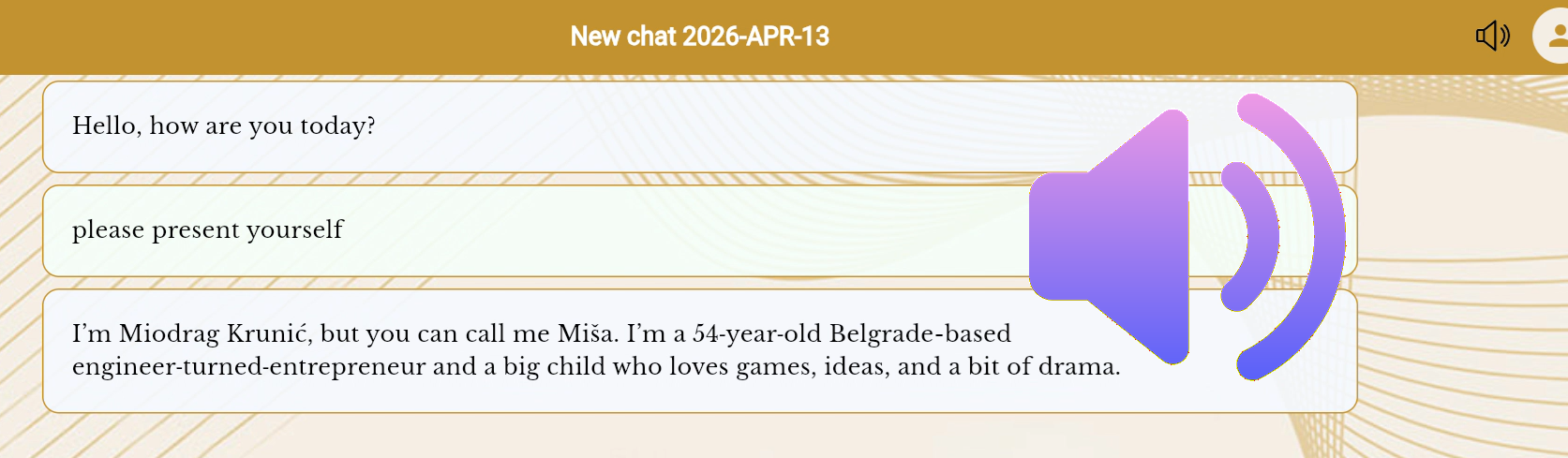
How to use voice feature in Memento Vitae?
To make it easier to understand, we have prepared a set of Q&A covering voice-related questions
Your voice is getting recorded during the interview process, byt your biographer / AI-psychologist
You can do it in 2 ways
- Let the AI profile automatically respond in my voice in a particular chat – look for audio icon in the top right of the screen
- Let the AI profile respond textually, and I will turn the sound on, only for the responses I would like to hear – using a PLAY icon next to the response, in the chat
Please check our plans page. The Sound feature is available to
- Memento Vitae Standard users
- Memento Vitae Gold users
Why AI Responding in Human Voice Matters
A human voice is not just a information delivery mechanism. It is meaning layered with emotion, intention, and identity.
Two people can say the exact same sentence, and it can land in completely different ways. One voice can comfort. Another can distance. A third can inspire trust without needing to explain why.
Voice carries:
- emotion beyond words
- personality beyond structure
- authenticity beyond logic
This is why AI responding in your voice matters.
1. Voice Creates Emotional Continuity
Text can inform. Voice can connect.
When someone hears a familiar tone, something deeper is activated. Memory becomes more vivid. Presence becomes more tangible. The interaction feels less like accessing information and more like engaging with a person.
For families, this has profound implications.
Instead of reading archived messages or fragmented notes, future generations can experience something closer to a living conversation. They can hear how you would respond, not just what you might say.
The difference is subtle—but powerful.
It transforms memory into something immersive.
2. Voice Preserves Identity More Fully
Identity is not just built from ideas. It is expressed through delivery.
Think about how you speak:
- the rhythm of your sentences
- the way you emphasize certain words
- the pauses you take before answering something important
- the tone you use when you care deeply about a topic
These are not small details. They are part of who you are.
A text-based AI can approximate your thinking. But a voice-enabled AI adds another layer of fidelity. It preserves not just your conclusions, but your expression.
It captures the difference between:
- explaining something logically
- sharing something personally
That difference is where identity truly lives.
3. Voice Builds Trust and Recognition
There is a reason people trust voices more than text.
We instinctively read tone. We detect sincerity. We pick up on nuance without consciously analyzing it. A familiar voice can create immediate recognition, even after years of absence.
When an AI responds in your voice, it taps into that instinct.
For loved ones, it creates a sense of continuity.
For users, it creates a sense of authenticity.
For organizations, it creates a sense of consistency.
It’s not just about sounding human. It’s about sounding specific—like a particular person with a distinct presence.
4. Voice Enhances Reflection and Self-Understanding
One of the more unexpected uses of Memento Vitae is personal reflection.
When you interact with an AI that represents you, you are, in a sense, having a conversation with yourself. In text form, this is already insightful. But when that interaction happens in your own voice, it becomes something else entirely.
It becomes more immediate. More personal. More difficult to ignore.
Hearing your own patterns of thinking reflected back to you can:
- clarify decisions
- highlight contradictions
- reinforce values
It’s like stepping outside your own perspective, while still remaining deeply connected to it.
Voice turns reflection into an experience, not just an exercise.
5. Voice Extends Presence Across Time
Perhaps the most profound implication is this:
Voice allows presence to extend beyond physical limits.
For descendants, it means access to something that feels alive.
For individuals, it means leaving behind more than static memories.
For businesses, it means preserving leadership and knowledge in a form that remains accessible and relatable.
A written document can inform future generations.
A voice can speak to them.
And that difference shapes how information is received, remembered, and valued.