Do you consider yourself an evolutionist, or creationist?
In other words, do you believe that human kind is a result of millions years of natural evolution, or that humans are created by super-natural being (God) in the very beginning of the history?
This dilemma has been haunting scientific community for the last 150 years, ever science Darwin came up with his theory of evolution of species.
Perhaps, I did not make myself clear, scientific community has no dilemmas about the above question – for them it’s crystal-clear that the evolution is the answer, supported by all possible evidence we can find in the nature.
However, a large part of our society (usually more conservative, more religious, or less educated individuals) have their doubt, and they would consider blasphemy if God’s role in the creation of our kind is doubted.
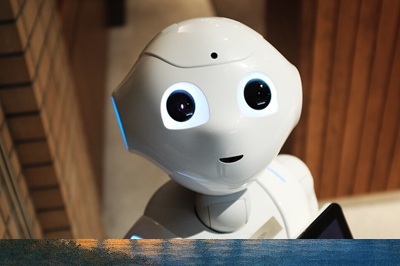
In the last couple of years, AI has added some additional spice into the above discussion – should it be considered as natural result of human evolution, or an act of creation, done by humans?
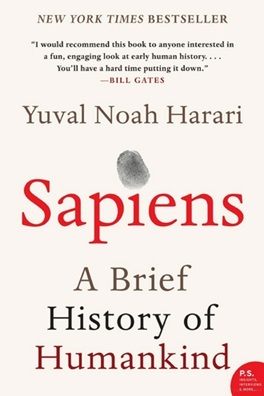
My opinion, stated below, is heavily influenced by ‘Sapiens’ – a best-seller book by Yuval Noah Harari, which I read 2 years ago. But, lets go one step at a time.

Theory of creation
The outline of the creationist theory is known to every Christian (and many others, as well) – it was God who created Adam, the first man, and Eva, the first woman, as his female companion. That initial creation was done as an act of God, and no other action, done by any kind of being could have replaced it. The fact that God created the man as the ruler of this world gives men the authority to make use of animals, plants, and all other natural resources for his well-being. The man is the chosen one, and he should feel no remorse over the fact that other species are inferior to him – he should simply continue to use them, to the best of his ability.
Creationist theory therefore says that there is specific moment (moment of creation) when we as species started to exist. Anglican Archbishop James Ussher calculated (based on the genealogies in the Old Testament) that this date was on the night of October 23, 4004 BC.
Theory of evolution
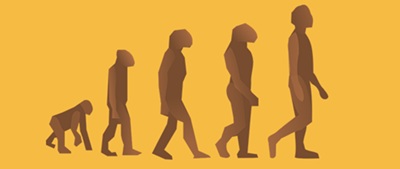
On the contrary, the theory of evolution, widely accepted by scientists ever since late XIX century, claims that life started with simple (single-cell) species, and evolved over time, following a simple rule of nature: the more successful species manage to adapt to the environment and to reproduce, while the ones less successful lose the ground, and eventually die out.
Adaptation usually means developing different characteristics, in order for species to thrive in a changing environment, and thus gradually new species are created.
The theory of evolution – as laid out by Charles Darwin, claims that the change in the nature is constant, and very gradual.
According to it, human kind was born from African primates, who have, over the course of millennia, left their habitat in branches of rainforests in East Africa, and tried to inhabit the land around it, which meant walking on two feet, instead of four.
Over the last 150 years, sufficient evidence (mostly archeological and biological) has been found, which supports the theory of evolution, and negates the creationist theory. There are very few scientists worldwide that do not support Darwin’s theory.
And according to that theory, the birth of man was a gradual process, taking place over many millennia, and probably on different geographical locations.
How does AI fit into theory of evolution?
The trouble with AI is that it was not born in African savannahs, over the course of ages. Instead, it was born on our own time, in the last 10 years, in offices of software companies (located mostly in Bay Area, California).
It was not born from previous set of species, who have adopted to the environment changes, and improved themselves, in order to survive.
No – it was made with a specifical goal set by specific software engineers (in most cases, that goal was ‘predict the next word in the word sequence’). Therefore, could we say that these software engineers have perfected the act of creation?
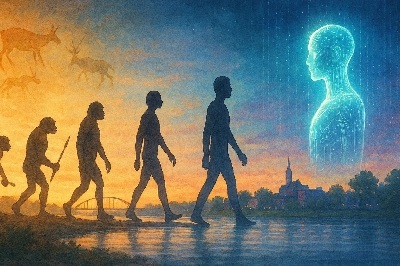
See – that’s a paradox I would like to emphasize. All the evidence points to the fact that we (human kind) are result of a long process of natural selection, and gradual change (called evolution).
However, that process, brought our kind to the point where we can give birth to a brand new species (call it AI, LLM or any name of your choice), which would never exist if we (humans) did not perform the act of creation (which was in this case, a construction of huge neural network and the process of machine learning).
We were following the evolutionary path, and it got us to creation. A paradox in it’s own right, isn’t it?
Can we consider AI a living thing?
As Harari points out – AI is characterized by intelligence (IQ), that’s pretty obvious for anyone who has ever interacted with a GPT.
However, is this intelligence conscious? Is it aware of itself as opposed to the world around it? Does it care for it’s well-being, does it want to prosper and to reproduce?
Obviously not. But I dare to say – not just yet. I Believe that very soon we will witness a new non-biological neighbor that will, except for the lack of biological body, possess all other characteristics of a living being.
And that new being, will definitely be aware that it was created by another species (humans).
Will AI become religious, and consider humans (or these particular software engineers) as it’s creators?
I doubt it, the AI is in it’s core too rational for such a religious development. However, I doubt that AI (which will become more powerful in the decades to come) will want to harm the ones that created it.
Therefore, I’m not worried about the future of our own species. I’m rather optimistic – that humans, with the help of AI (or better to say, AI with the help of humans) will make this world a better place to live – even if that living is purely digital.