
How we conducted the poll
A few weeks ago, Memento Vitae carried out a cross-platform survey to understand how people around the world perceive artificial intelligence in their daily lives. The poll, titled “Is AI making this world a better place?”, was shared on X (formerly Twitter), Instagram, Facebook, LinkedIn, and Reddit.
By spreading it across platforms that attract very different audiences—from tech enthusiasts on Reddit to professionals on LinkedIn and everyday users on Instagram—we hoped to capture a diverse picture of public opinion. Each participant could choose one of three answers: Yes, No, or Not sure. Not all platforms had equal share of votes – but we should emphasize that Reddit has the largest share of votes, which is probably good, as Reddit attracts very broad, non-biased public.
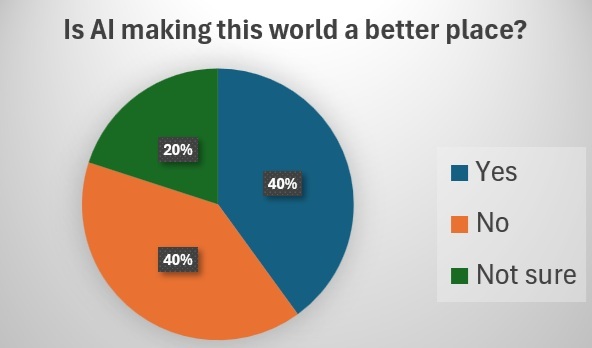
After hundreds of votes, the outcome was surprisingly balanced (please note that we have not rounded the resulting numbers – they are stated exactly as voted)
- 40% — YES
- 40% — NO
- 20% — NOT SURE
These results show that global sentiment toward AI is evenly split: for every person who believes AI improves our world, there is another who thinks it does not. The remaining fifth remain uncertain, reflecting both curiosity and caution.

What the Results Tell Us – AI has Polarized the World
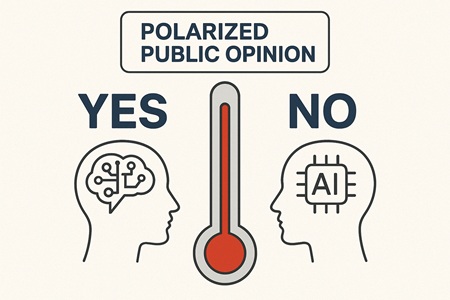
The findings reveal that our society stands at a crossroads regarding AI. While some view artificial intelligence as a driver of progress—accelerating innovation, improving healthcare, or just simplifying everyday life—the same amount of people worry about job loss, misinformation, and the erosion of human ethical values.
This 40–40–20 distribution mirrors the broader polarization we often see in political and social debates today. People are increasingly aware that AI is not just a technological phenomenon but a cultural and ethical one, unprecedented in human history. It influences how we communicate, work, and even how we remember the past—precisely the issues that Memento Vitae explores through its AI-based legacy service for remembering our elderly.
Why 40 % Believe AI Is Making the World Better
Those who voted “YES” often point to AI’s tangible benefits and human-centred applications. From our interactions and comments during the poll, several recurring themes emerged:
- Medical progress: AI diagnostics and predictive algorithms are saving lives by detecting illnesses earlier and improving treatment accuracy.
- Accessibility and inclusion: Speech recognition, translation tools, and assistive technologies help bridge language and disability barriers.
- Efficiency in everyday life: AI streamlines tedious tasks—whether it’s managing household devices, organizing calendars, or enhancing public services.
- Creativity and personalization: Many respondents mentioned how AI tools boost creativity, giving everyone—from students to retirees—the ability to write, paint, or compose music.
At Memento Vitae, we see another dimension: AI as a tool of emotional continuity. Our service allows people to preserve their life stories and wisdom as an AI profile that future generations can interact with. For many elderly users, this offers comfort, meaning, and a sense that their experiences will remain accessible after they are gone. That emotional benefit may be one of the most profound “YES” arguments in favour of AI.
Why 40 % Said No
The “NO” respondents tend to view AI as a disruptive and potentially harmful force. Their concerns revolve around loss of control, ethical ambiguity, and social consequences:
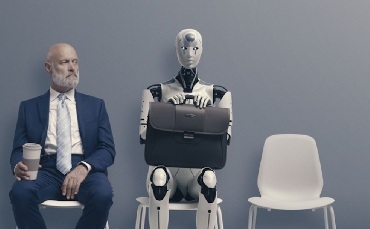
- Job displacement: Automation threatens millions of routine jobs, leaving uncertainty about what work will mean in the future.
- Misinformation and manipulation: AI-generated content can easily blur the line between truth and fabrication, undermining trust.
- Privacy fears: Data collection and surveillance create legitimate anxiety about who controls personal information.
- Loss of authenticity: Some believe AI erodes human creativity, empathy, and interpersonal connection—traits that define our humanity.
- Energy consumption – AI is consuming huge number of Gigawatts as we speak. This will drive the energy prices up, and create even more environmental issues
- Catastrophic fears – we must forget that there is a percentage of population who is genuinly afraid that AI will wipe out the humanity, or at least use us, like in The Matrix
Interestingly, these concerns aren’t limited to technophobes. Many people who use AI daily still feel uneasy about its speed and lack of clear regulation. Their “NO” reflects a demand for accountability, transparency, and ethical standards.
Why 20 % Remain Unsure
The “Not sure” group represents a silent middle ground—people who see both sides. They recognize AI’s potential but hesitate to judge its overall impact.
Their uncertainty often comes from limited understanding. AI is complex, and most users only encounter its surface layer—chatbots, recommendations, or voice assistants—without knowing how these systems learn or decide. Another reason is information fatigue: between utopian promises and dystopian warnings, it’s hard to know whom to trust.
Interestingly, these concerns aren’t limited to technophobes. Many people who use AI daily still feel uneasy about its speed and lack of clear regulation. Their “NO” reflects a demand for accountability, transparency, and ethical standards.

How to Build a Better Perception of AI
If we want AI to be perceived more positively, both developers and institutions must act responsibly.
- Transparency: People need clear explanations of what AI does with their data and how its decisions are made.
- Human purpose first: AI should be seen as a tool to enhance human dignity, not to replace it.
- Education and empathy: Teaching digital literacy from school to retirement age can transform fear into curiosity.
- Ethical storytelling: Companies like Memento Vitae can showcase how AI can serve deeply human goals—such as memory preservation, family connection, and emotional wellbeing.
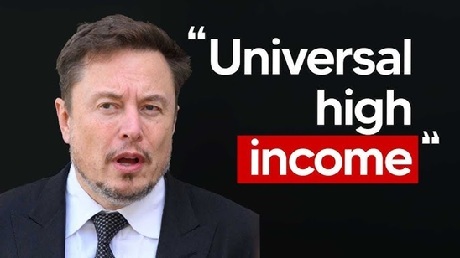
- Make no promises that can’t be made true – we’re specifically referring to Elon Musk’s comments on universal guaranteed income
Our experience shows that when AI is presented not as a cold algorithm but as a compassionate bridge between generations, perceptions shift dramatically. Many of our elderly clients report a sense of peace knowing that their experiences, humour, and values will live on in a form their grandchildren can interact with. In this way, AI becomes an ally of mental health, helping people cope with the passage of time and loss.estingly, these concerns aren’t limited to technophobes. Many people who use AI daily still feel uneasy about its speed and lack of clear regulation. Their “NO” reflects a demand for accountability, transparency, and ethical standards.
Why Have Political Parties Stayed Silent on AI?
One surprising insight from our discussions is the absence of clear political positions on AI. Despite its massive influence on the economy, labour market, and privacy, few political programmes address it explicitly.
There are several reasons:
- Pace: AI evolves faster than legislation, making it hard for policymakers to keep up.
- Understanding: Politicians may fear dividing their voters over a topic they don’t fully understand.
- Short-term focus: Electoral cycles favour immediate issues—taxes, pensions, healthcare—over long-term technological ethics.
- Big-tech interests: Lets face it, AI services are provided by some of the largest world companies – which certainly do excercize influence on many political parties.
Yet, the longer this silence persists, the more disconnected public policy becomes from everyday digital reality. Societies need clear frameworks on data rights, AI education, and psychological wellbeing in an increasingly automated world.

A Closing Reflection
Memento Vitae’s poll didn’t deliver a simple verdict—it revealed a mirror of our collective hopes and anxieties. The 40–40–20 split shows that AI is neither universally loved nor feared; it’s debated, experienced, and felt.
At Memento Vitae, we believe that the future of AI will depend less on its technical capabilities and more on its emotional intelligence—on how it helps us preserve empathy, memory, and connection. If we use AI to strengthen what makes us human, not replace it, then perhaps, in our next poll, the answer will tilt more decisively toward “YES.”