
When we think of IKEA today, we imagine sleek Scandinavian minimalist design, and the flat-pack revolution that changed how the world shops furniture. But behind that global brand stands one man — Ingvar Kamprad — whose personal story reflects the ingenuity, discipline, and contradictions of 20th-century Europe.
But, wait – how can Ingvar Kamprad, who died in 2018, be related to Memento Vitae, a service that was launched in 2025? Please read on, especially the very last chapter 🙂

Founding IKEA in the Midst of World War II
Ingvar Kamprad founded IKEA in 1943, when he was just 17 years old — in the middle of World War II. Born in 1926 on a small farm in Småland, Sweden, Kamprad was known early on for his entrepreneurial spirit. As a child, he sold matches, fish, and Christmas cards to neighbors, saving every krona he earned.
Sweden remained neutral during the war, but its citizens faced rationing and shortages. It was precisely this environment that taught Kamprad the values of resourcefulness and frugality — principles that would later define IKEA’s identity. He registered IKEA as a mail-order business, selling small household goods like pens, wallets, and picture frames.
The company’s name came from his own initials (IK: Ingvar Kamprad), his family farm (Elmtaryd), and his home village (Agunnaryd). Even in its name, IKEA carried Kamprad’s roots — rural, pragmatic, and deeply Swedish.

Early Days and Company Growth
By the late 1940s, Kamprad began adding furniture to his catalog. Sweden was picking the pace after stagnation during the war, and families needed affordable household goods. Yet traditional furniture was expensive and bulky to ship. Kamprad saw an opportunity: make well-designed furniture affordable for everyone by simplifying production and distribution.
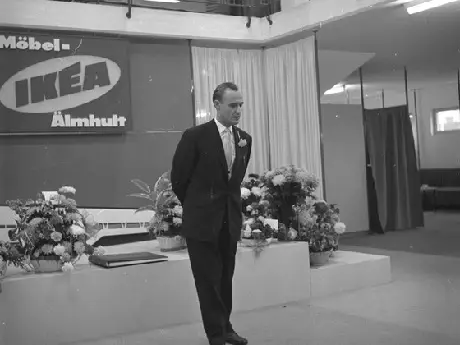
The turning point came in 1953, when IKEA opened its first furniture showroom in Älmhult. Customers could touch and test the furniture before ordering — a novel idea at the time. Around the same period, one of Kamprad’s designers, Gillis Lundgren, famously removed the legs from a table so it could fit into a car. This sparked the flat-pack concept, which became IKEA’s global hallmark.
Kamprad’s model was simple but revolutionary:
- Design products that could be mass-produced efficiently.
- Allow customers to assemble them at home.
- Keep prices as low as possible through volume and cost control.
By the 1960s and 70s, IKEA had expanded across Scandinavia and into Western Europe. The blue-and-yellow stores became symbols of modern living — democratic, accessible, and distinctly Swedish.
Management Style: The Frugal Visionary
Kamprad’s management style was famously unconventional. He distrusted corporate bureaucracy and believed that simplicity and thrift should guide every decision.
He often said, “Wasting resources is a mortal sin.” IKEA employees recall that Kamprad flew economy class, stayed in budget hotels, and encouraged staff to write on both sides of paper. Even as a billionaire, he drove an old Volvo and shopped in local markets.
Kamprad was deeply involved in every aspect of the business — from product design to store layout. He visited factories, talked to workers, and personally tested new ideas. Employees described him as humble yet demanding: he expected efficiency, loyalty, and an understanding that IKEA’s mission was greater than profit.
His leadership style created what some call “the IKEA culture”: a blend of egalitarianism, practicality, and relentless cost discipline. Managers were encouraged to think like entrepreneurs — questioning processes, minimizing waste, and staying close to customers.
However, this centralized control also meant that IKEA’s growth reflected Kamprad’s personality — visionary but sometimes rigid, frugal to the extreme, and resistant to outside influence.
The photo shows Kamprad’s Volvo 240. By this time this photo was taken, Kamprad was already a billionaire, and could have afforded a car much more luxurious.

Personal Affairs and Contradictions
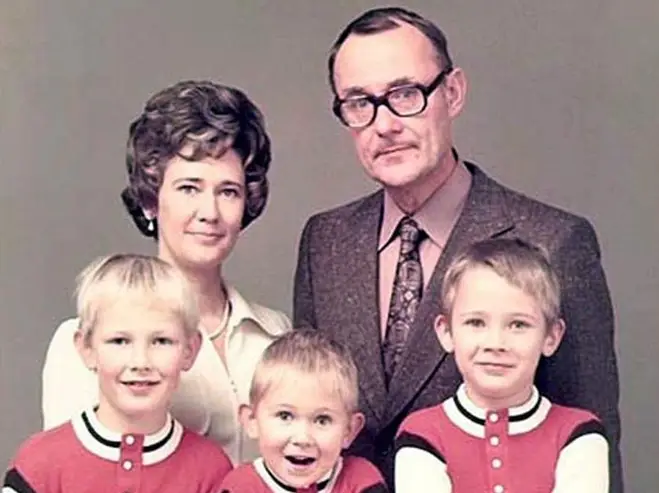
Kamprad’s personal life was as complex as his business philosophy. He married Margaretha Stennert in 1963, and together they had three sons: Peter, Jonas, and Mathias. Despite his immense wealth, he maintained a modest lifestyle and rarely sought public attention – keeping his family away from business turbulences.
Yet his biography also contained controversial chapters. In the 1990s, Swedish media revealed that Kamprad had briefly been involved with pro-Nazi youth movements in the early 1940s. He later called this “the greatest mistake of my life,” explaining it as youthful ignorance. The incident tarnished his reputation but did not derail IKEA’s momentum — many accepted his public apology and subsequent commitment to democratic and inclusive values.
Personally, Kamprad struggled with dyslexia, which influenced IKEA’s visual culture — the company famously names its products instead of using numeric codes, because names were easier for him to remember. This limitation became a creative strength, giving IKEA’s products their unique identity (Billy, Malm, Poäng…).
Move to Switzerland, return to Småland
In the late 1970s, Kamprad moved to Switzerland, officially for tax reasons but also to focus on IKEA’s growing international operations. He lived there for more than 40 years, first in Epalinges near Lausanne, then in the canton of Vaud.
While critics accused him of tax avoidance, Kamprad defended the move as a business necessity — enabling IKEA to reinvest more profits into global expansion. During this period, IKEA entered markets like Germany, the UK, and later the United States.
Even in Switzerland, Kamprad remained deeply connected to his Swedish roots. He continued to speak Swedish at home, visited Älmhult regularly, and ensured that IKEA’s corporate culture stayed anchored in the “Småland spirit”: humility, efficiency, and doing more with less.
He returned to Sweden in 2011, settling once again near his childhood home. When he passed away in 2018 at age 91, tributes poured in from around the world. IKEA’s 400 stores in over 50 countries stood as monuments to his enduring philosophy.
After Kamprad: Succession and Continuity
When Ingvar Kamprad passed away in 2018, many wondered how IKEA — a company so intertwined with his personality, led practically single-handedly over so many years — would move forward without him. His death marked the end of an era, but not the end of his influence. For decades before his passing, Kamprad had worked meticulously to ensure that IKEA’s ownership and governance would protect its independence and mission long after he was gone.
IKEA’s unique corporate structure was the cornerstone of this continuity. The company is owned by a complex network of foundations and holding entities, the most important of which is the Stichting Ingka Foundation in the Netherlands. This foundation controls the IKEA Group and reinvests its profits back into the company — a structure designed by Kamprad himself to safeguard IKEA from takeovers, short-term shareholders, or dilution of its values.
His three sons — Peter, Jonas, and Mathias Kamprad — did not inherit IKEA directly but took on advisory and governance roles across different branches of the enterprise. Mathias briefly served as chairman of Inter IKEA Group before stepping down in 2020, emphasizing that the family’s role would remain “custodial, not operational.”
The leadership of IKEA today rests in the hands of professional managers, yet the “Kamprad spirit” remains embedded in its culture. Employees still speak of “doing things the Småland way” — being frugal, practical, and close to customers. Even without its founder, IKEA continues to act as though Ingvar were still walking the aisles, checking the price tags, and reminding everyone:
“Most things remain to be done. A glorious future!”
Hypothesis: Kamprad Might Haved Used Memento Vitae to Guide IKEA Even After His Death
If a tool like Memento Vitae — a digital legacy platform that preserves one’s thoughts, values, and experiences through AI — had existed during Kamprad’s time, he would have likely embraced it as a continuation of his lifelong obsession with clarity, discipline, and continuity.
Kamprad believed that IKEA’s spirit was more important than its products. He worried that, after his death, corporate structures might erode the “Småland values” of modesty, efficiency, and closeness to the customer. Through Memento Vitae, Kamprad could have created an interactive version of himself — a digital mentor for future leaders — offering guidance on strategic dilemmas and ethical decisions.
Imagine IKEA executives consulting “AI Ingvar” (his Memento Vitae AI profile) before a major expansion:
“Would this decision still make furniture affordable for the many, not the few?”
Such an AI-driven reflection of Kamprad’s mind could serve as a moral and business compass — not replacing leadership, but reminding it of its origins.
Just as IKEA’s catalog became a manual for living, Memento Vitae would become a manual for leading — allowing Kamprad’s philosophy to evolve, learn, and inspire long after his passing. It would not only preserve his words but also simulate his judgment, ensuring that his company never loses sight of its founding purpose: to create a better everyday life for the many people.