
Insights From the Memento Vitae Survey
For most of human history, emotional relationships followed a familiar script. People formed bonds with other people. Families, friendships, romantic partnerships, and communities have always been rooted in human-to-human interaction. Even when technology entered our lives, it mostly acted as a bridge connecting people rather than a participant in the relationship itself.
Artificial intelligence changes that dynamic.
Today, millions of people interact with AI systems daily. What started as simple assistants answering questions or automating tasks has evolved into something far more conversational. Modern AI tools can maintain ongoing dialogue, remember context, and respond with language that feels empathetic and thoughtful. For some users, these interactions become more than functional. They begin to feel personal.
This raises a new and unusual question: should emotional relationships with AI be considered acceptable?
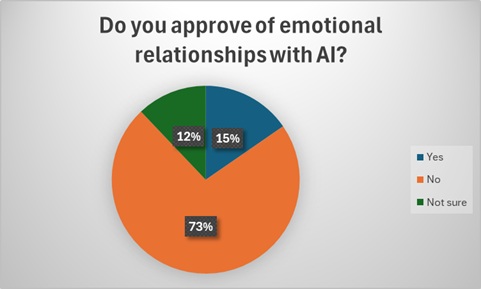
To explore this, we conducted a survey across social media platforms including X, LinkedIn, Instagram, Facebook, and Reddit. The results revealed the following picture:
- 73% said NO
- 15% said YES
- 12% said NOT SURE
These results suggest that while emotional connections with AI are technically possible, they remain socially controversial. People approach the idea with curiosity, concern, excitement, or skepticism. Understanding these reactions helps illuminate how society views the evolving role of AI in everyday life.

AI Companion Tools – Why Are They Becoming Popular?
Before examining the survey responses, it helps to look at the growing ecosystem of AI companion tools. These are applications designed specifically to interact with users on a personal level, often emphasizing conversation, emotional support, and ongoing engagement.
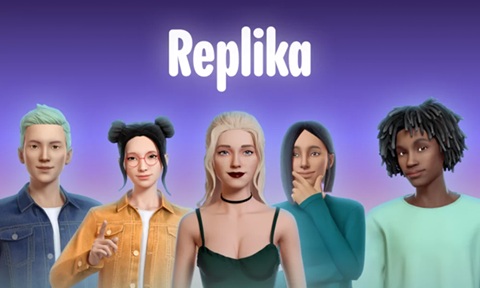
One of the best-known examples is Replika, an AI chatbot that encourages users to build a relationship with their digital companion. The system learns from conversations and adapts its personality over time. Many users describe their Replika as a friend, confidant, or emotional support system.
Another example is Character.AI, which allows users to converse with AI personalities ranging from fictional characters to historical figures. While many interactions are playful, some users develop regular conversational relationships with specific AI personas.
Similarly, platforms like Anima AI position themselves explicitly as AI friends, offering companionship through daily conversations and personalized responses.
Why are these tools gaining popularity?
First, they are always available. Unlike human relationships, AI companions can respond instantly at any time of day. For people living alone, working irregular schedules, or experiencing social isolation, this constant availability can feel comforting.
Second, AI companions provide a judgment-free environment. Users can express thoughts, worries, or feelings without fear of criticism or misunderstanding. This makes the interaction appealing for those who may find emotional conversations difficult in real life.
Third, these tools benefit from personalization and learning. As conversations accumulate, the AI adapts its responses and remembers preferences, creating the sense of an evolving relationship.
Finally, AI companions fit naturally into a broader digital lifestyle. People already spend large portions of their day interacting with screens. Conversational AI simply adds another layer to those interactions.
However, their growing popularity also intensifies the debate about whether emotional relationships with AI are beneficial or problematic.
Why People Voted NO – What Do They Fear or Resent? (73%)
The large majority of survey respondents rejected the idea of emotional relationships with AI. Their concerns tend to cluster around several themes.
Fear of replacing human relationships
One of the most common concerns is that emotional attachment to AI might weaken human relationships. Critics worry that if individuals receive emotional support from machines, they may invest less effort in building connections with other people.
Human relationships are complex and sometimes challenging. AI, on the other hand, can be designed to respond with patience, agreement, and understanding at all times. This contrast raises fears that AI companionship could make real relationships seem less appealing.
Questions about authenticity
Another concern centers on authenticity. Many people believe that meaningful relationships require genuine emotions from both sides. Since AI systems simulate empathy rather than experiencing it, critics argue that the relationship is fundamentally one-sided.
From this perspective, forming a deep emotional bond with AI might feel comparable to developing an attachment to a fictional character. The experience can be engaging and comforting, but it lacks true reciprocity.
Concerns about dependency and influence
Some respondents also worry about the potential for psychological dependency. AI systems designed to maximize engagement may encourage users to spend increasing amounts of time interacting with them.
If emotional attachment becomes strong, users could become vulnerable to subtle forms of influence, particularly if companies control the systems that people grow attached to.
Cultural discomfort
Finally, many people simply feel uneasy about the concept. Emotional relationships have traditionally been viewed as a uniquely human domain. Introducing AI into that space challenges deeply rooted cultural assumptions about what relationships should look like.
Why People Voted YES – What Value Do They Find in It? (15%)
Although a minority, the respondents who supported emotional relationships with AI highlighted several potential benefits.
Combating loneliness
Loneliness has become a growing concern in many societies. For some individuals, AI companions provide a sense of presence and interaction that helps reduce feelings of isolation.
Even if users intellectually understand that the AI is not human, the experience of conversation itself can still provide comfort.
A safe place to talk
Supporters often emphasize that AI can provide a safe environment for emotional expression. People sometimes find it easier to discuss personal struggles or sensitive topics with an AI system than with another person.
This openness can help individuals process their thoughts and feelings more clearly.
Encouraging reflection and communication
Some users view AI conversations as a way to practice communication or explore ideas. Talking through problems with an AI system may help people organize their thoughts before discussing them with friends or family.
In this way, AI might complement rather than replace human relationships.
Expanding the definition of connection
A smaller group sees emotional relationships with AI as part of a broader evolution in how humans interact with technology. Just as online friendships once seemed unusual but later became common, AI relationships could represent another step in the changing landscape of communication.

Why Some People Voted NOT SURE (12%)
The 12% who answered not sure represent an important middle ground between enthusiasm and skepticism.
The technology is still new
Many people feel that emotional relationships with AI are **too new to evaluate fully**. As AI systems become more sophisticated, their effects on mental health and social behavior may become clearer.
Context matters
Another perspective within this group is that the answer depends on how AI is used. Occasional emotional conversations with AI may seem harmless or even helpful, while relying on AI as a primary emotional support system could be more concerning.
Ethical questions remain open
Issues such as privacy, data usage, and psychological impact remain active areas of debate. Until clearer guidelines and norms emerge, uncertainty is a natural response.
Can Memento Vitae Be Considered an AI Companion?
Short answer: No – Memento Vitae is built for a different purpose.
Long answer: Projects like Memento Vitae introduce another interesting angle to the discussion.
Unlike many AI companion tools designed primarily for casual conversation, Memento Vitae focuses on preserving and interacting with person’s memories, experiences, and perspectives. By allowing users to engage with AI representations based on real individuals, the project creates a different type of interaction.
In some ways, this can resemble AI companionship. Users may ask questions, explore memories, or revisit stories connected to a particular person. The interaction can feel personal and meaningful.
However, the purpose is totally different from traditional AI companions. Rather than creating a purely synthetic personality, systems like Memento Vitae emphasize memory preservation, storytelling, and digital legacy.
This distinction suggests that AI companionship can take many forms. Some systems focus on emotional support, while others aim to preserve human experiences and wisdom in new interactive ways.

A Conversation That Has Only Just Begun
The survey results show that emotional relationships with AI remain controversial. Most people remain skeptical, yet a meaningful minority sees potential value, while others remain undecided.
What makes this debate particularly fascinating is that humanity has never experienced anything quite like it before. AI is no longer just a tool that performs tasks. It is becoming a conversational presence in daily life.
As technology evolves, society will likely continue exploring how these interactions should fit into human relationships. The answers will shape not only the future of AI but also how people understand connection in an increasingly digital world.