
Introduction — About the Survey and Its Connection to Memento Vitae
At Memento Vitae, our mission is simple: to help people preserve their stories, values, memories, and unique voice through AI. Because we work at the intersection of technology and human identity, understanding how people feel about artificial intelligence is essential, especially knowing that we did face some unexpected resistance towards AI, particularly with elderly clients. That’s why, in November 2025, we launched a cross-platform survey “Are you afraid of AI?” and conducted it across X, Instagram, LinkedIn, Facebook, and Reddit.
That is why we have launched a serious of surveys, with the aim of how broad public perceives AI, and what can we do ti increase the trust.
First such survey was conducted in October – it’s question was ‘Is AI making this world a better place‘ – and now we’re presenting second survey in this series.
The aim was not simply to gather numbers, but to listen. As a company that uses AI to build digital legacy profiles, we wanted to understand whether the general public sees AI as a helpful companion or as something unsettling. The results provide both clarity and direction.
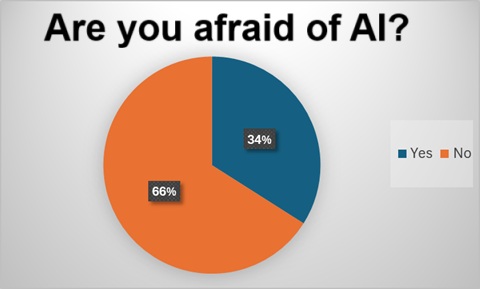
Across all platforms combined:
-
66% voted NO — they are not afraid of AI
-
34% voted YES — they are afraid of AI
While simple at first glance, these numbers tell a complex story about trust, awareness, and the rapidly evolving relationship between humans and intelligent tools.

Why do the results matter?
These results matter because fear — or lack of fear — shapes how people adopt new technologies. For Memento Vitae, this is particularly important because our product deals with something deeply personal: one’s identity, memories, and voice.
A higher level of NO vote (the 66%) tells us that most users are ready to interact with AI in meaningful, emotionally significant ways. They’re open to the idea that AI can help document a life story or preserve a legacy for future generations. Our survey did not ask for age, but we feel that younger population is mostly in this group.
But the remaining 34% (YES vote) is equally important. These respondents highlight real concerns: uncertainty about data usage, worries about impersonation, fear of losing control, or discomfort with rapid technological change. These concerns help guide our design, transparency, and communication strategies.
Understanding both sides ensures that the AI we build remains responsible, trustworthy, and human-centric.
Platform Differences — Where People Are the Least Afraid
One of the most interesting findings was how the survey outcome shifted between platforms.
Although the general result averaged 66% “Not afraid,” the distribution was not uniform:
-
LinkedIn had the lowest percentage of people afraid of AI.
This is not surprising. LinkedIn’s audience is mainly business professionals, tech workers, managers, and early adopters. For them, AI represents opportunity: automation, productivity, career acceleration, innovation. The tone of discussion on LinkedIn is also generally more analytical and optimistic. As a result, users there reported the highest comfort with AI. -
Instagram and Facebook showed similar patterns, with a moderate majority not afraid, but with a noticeable presence of skepticism. These platforms host users of all ages and digital literacy levels, so concerns vary widely — from privacy to job displacement or general unease about “machines that think.”
-
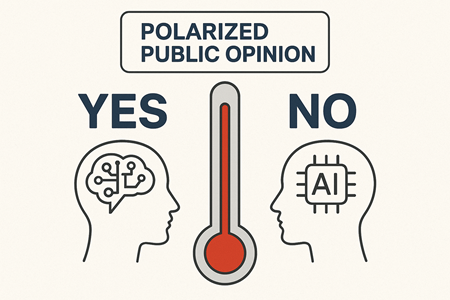
X showed mixed results. Discussions about AI there are more polarized, with enthusiastic adopters and strong skeptics coexisting. The vote leaned positive, but fear levels were higher than on LinkedIn.
-
Reddit had the highest share of AI-skeptical votes after Facebook.
Reddit communities are diverse, and many tech-savvy discussions include criticism of AI ethics, corporate control, training data, and long-term risks. This naturally increases the “afraid” percentage.
These differences show that attitudes toward AI are influenced not just by the technology itself, but by the surrounding culture of each platform.
How Do Our Results Compare with Other Surveys
When compared to most public surveys conducted in the last couple of years, our results fit into a global trend:
-
Pew Research (2025) found that around 38% of Americans were worried about AI — almost identical to our 34%. Please note that this suervey was conducted in US only, while our survey was global.
-
YouGov (2024) reported that younger adults tend to be less fearful, while older respondents show higher concern.
-
European Commission surveys across 2023–2024 showed that Europeans generally trust AI for practical tasks but remain cautious about AI in personal or emotional contexts.
In other words, our findings are not an outlier. The world is roughly split two-thirds optimistic and one-third concerned, depending on age, profession, education, and exposure to technology.
The difference is that our survey was taken across general consumer social networks rather than within a specific demographic. This makes it a more genuine reflection of broad, everyday sentiment.

Why Are People Afraid of AI?
Memento Vitae plans to conduct a more detailed survey on this topic in months to come – but right now, the key reasons look as following
1. Fear of losing control
AI systems can make decisions quickly and at scale. For some people, even simple automation feels like “giving power away.”
2. What will happen to my job
Automation in writing, design, coding, and analytics has made people worry about long-term job security — especially in predictable or repetitive professions.
3. Concerns about privacy and data misuse
People don’t always know where their data goes or how AI models learn from it. This uncertainty naturally creates distrust.
4. Fear of impersonation or identity misuse
As AI becomes better at generating voices and personalities, some worry about authenticity. This is especially relevant in legacy-related AI — and it’s why consent, verification, and clear boundaries are essential.
5. Religious and psychological fears
Films, books, and media have often portrayed AI as dangerous or uncontrollable. Even if unrealistic, these images shape emotions.
6. Fear of the unknown
Humans are naturally cautious with new technologies, especially when change is rapid. For some people, it simply feels like too much, too fast.
All these fears are valid — and acknowledging them is the first step toward addressing them.
What Can We Do to Reduce This Fear?
To make AI feel safer, more transparent, and more human-aligned, several actions can be taken — not just by Memento Vitae, but by the entire AI industry:
Increase transparency
People trust AI more when they understand how it works, why it makes certain decisions, and what happens with their data.
Make humans unerstand they are in full control
Users should always have the final say — over their data, their AI profile, and how their information is used.
Build strong verification and consent systems
Especially in the domain of digital legacies, it must be crystal clear that AI cannot imitate someone without permission.
Education, with no hype
Clear, simple explanations reduce fear much better than futuristic promises or exaggerated capability claims.
Emphasize positive, practical use cases
When people see AI helping families stay connected, supporting elderly individuals, or preserving personal histories, fear transforms into curiosity.
Pay attention to ethics as much as innovation
Trust grows when users see that ethics are not an afterthought but part of the design itself.
Conclusion
Our simple question — “Are you afraid of AI?” — sparked deep reactions across platforms. The majority is open and optimistic, but a meaningful minority remains cautious. For Memento Vitae, these results are not just statistics; they are a roadmap. They show us where to reassure, where to educate, and where to innovate responsibly.
In the end, AI doesn’t replace people — it extends their stories. And by understanding how people feel, we can build technology that supports them, not scares them.